






























































Bridging Intuition and Innovation in Bank Branch Audit with Domain Expertise, Knowledge and AI

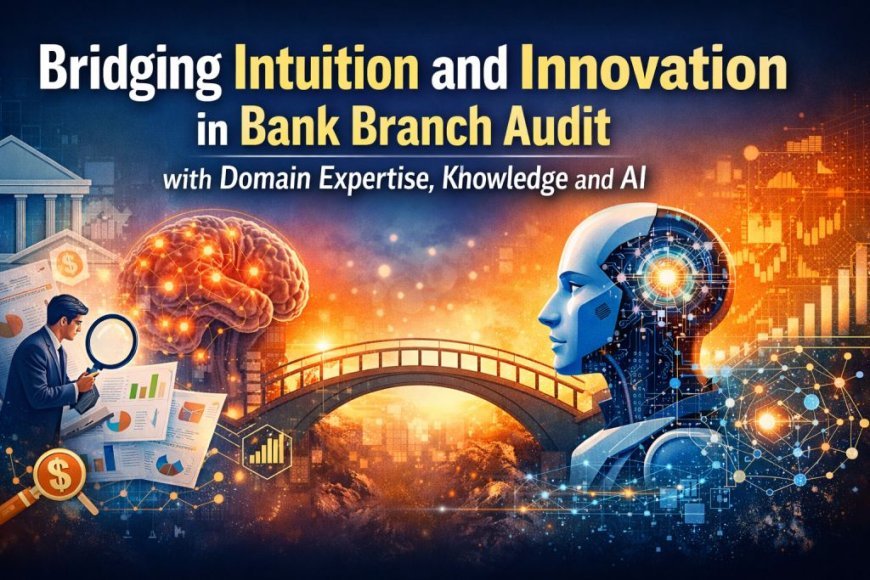


The global banking sector is undergoing a profound structural transformation characterized by the convergence of advanced computational power and the enduring necessity of human judgment. As financial institutions expand their digital footprints and the volume of transactional data grows exponentially, the traditional methodologies of bank branch auditing are being re-evaluated to address the complexities of a modern, data-driven economy.
The Cognitive Foundation: Domain Expertise and Professional Skepticism
At the heart of every effective audit lies the concept of professional skepticism, a mindset that includes a questioning mind and a critical assessment of audit evidence.
The ethical dimension of this expertise is codified in fundamental principles such as integrity, objectivity, professional competence, and due care.
| Fundamental Principle | Description in Auditing Context | Relevance to AI Integration |
| Integrity |
Straightforwardness, honesty, and professional courage. |
Ensuring AI models are used ethically and their limitations are disclosed. |
| Objectivity |
Impartial mindset free from bias or undue influence. |
Identifying and mitigating algorithmic bias in automated decisions. |
| Professional Competence |
Attainment and maintenance of required knowledge and skills. |
Developing data literacy to interpret and validate AI-driven insights. |
| Due Professional Care |
Diligent application of standards and sound judgment. |
Exercising skepticism when reviewing AI-generated flags and alerts. |
| Confidentiality |
Respecting the privacy and security of sensitive information. |
Safeguarding data used in training and deploying machine learning models. |
The Statistical Reality: Deconstructing Traditional Sampling Limitations
For much of its history, auditing has relied on sampling—the application of audit procedures to less than 100 percent of the items within an account balance or class of transactions.
Traditional audits often utilize sample sizes as small as 15 to 30 items, raising concerns about whether these subsets are truly representative of thousands or millions of transactions.
| Audit Constraint | Impact of Traditional Methods | Implication for Modern Banking |
| Testing Scope |
Limited to small representative samples. |
High probability of overlooking subtle or low-frequency fraud. |
| Risk Assessment |
Often reactive and backward-looking. |
Delays in identifying systemic control failures or emerging risks. |
| Manual Processes |
Labor-intensive and prone to human error. |
High operational costs and resource strain on audit teams. |
| Evidence Collection |
Sifting through paper and siloed digital files. |
Time-consuming processes that hinder real-time decision-making. |
| Analysis Depth |
Focus on rule-based compliance and numerical accuracy. |
Difficulty in uncovering hidden relationships or complex patterns. |
The transition toward innovation seeks to eliminate these constraints through full-population testing.
Technological Building Blocks: Machine Learning and Artificial Intelligence
The innovation component of the audit bridge is constructed using a diverse array of AI technologies, including Machine Learning (ML), Deep Learning, and Natural Language Processing (NLP).
Machine Learning and Predictive Analytics
Machine Learning serves as the primary engine for anomaly detection and risk scoring. Unlike traditional rule-based systems that flag transactions based on rigid, predefined criteria—such as "flag all transfers over $10,000"—ML models learn from historical data to identify complex, non-linear relationships.
Unsupervised learning is particularly valuable for identifying "unknown unknowns"—new types of fraud or operational failures that have not yet been categorized.
Deep Learning and Network Analysis
Deep learning, which utilizes multi-layered neural networks, excels at capturing intricate patterns in massive datasets.
| AI Model Class | Primary Application in Audit | Key Benefit |
| Supervised Learning |
Fraud probability scoring and credit risk assessment. |
High accuracy in identifying known fraud typologies (up to 87-94%). |
| Unsupervised Learning |
Anomaly detection and clustering of outliers. |
Identification of new, emerging threats without explicit programming. |
| Deep Learning |
Analyzing unstructured data and hidden entity networks. |
Detection of complex laundering patterns and multichannel attacks. |
| Natural Language Processing |
Scanning loan documents and summarizing narratives. |
Significant reduction in manual document review time (30-70%). |
| Predictive Modeling |
Forecasting cash flows and delinquency trends. |
Proactive identification of NPA risks and operational bottlenecks. |
Natural Language Processing: Unlocking Unstructured Data
A significant portion of bank branch activity is recorded in unstructured formats, including loan files, account opening documents, compliance paperwork, and customer correspondence.
NLP applications in branch auditing include the automated extraction of data from scanned loan agreements to verify that terms match the core banking system.
Robotic Process Automation: The Efficiency Engine
Robotic Process Automation (RPA) complements AI by handling high-volume, deterministic tasks across different systems.
Layering AI on top of traditional RPA—a process known as Intelligent Process Automation (IPA)—allows these digital agents to read documents, classify exceptions, and learn from historical outcomes.
Generative AI: The New Frontier of Audit Interaction
The emergence of Generative AI (GenAI) introduces a new dimension to auditing by enabling deeper reasoning and structured interpretations of financial data.
Generative models can also support scenario simulation and stress testing by creating synthetic financial data.
The Regulatory Mandate: RBI Master Directions and FREE-AI
The integration of AI into bank auditing is not merely a choice for innovation but is increasingly a regulatory requirement. In India, the Reserve Bank of India (RBI) has issued comprehensive directions to enhance IT governance, risk management, and assurance practices among regulated entities (REs).
A critical component of this framework is the Information Systems (IS) audit, which must be independent and risk-based.
| RBI Directive / Framework | Key Requirement for Banks | Impact on AI Audit |
| Master Direction (April 2024) |
Establish Board-level IT Strategy and Steering Committees. |
Ensures AI initiatives are aligned with business strategy and risk appetite. |
| IS Audit Policy |
Mandates risk-based audits of critical systems and processes. |
Requires auditors to validate the performance and security of AI models. |
| FREE-AI Report (Aug 2025) |
Adoption of the Seven Sutras for responsible and ethical AI. |
Mandates transparency, fairness, and accountability in algorithmic decisions. |
| NBFC Outsourcing (Nov 2025) |
Ongoing risk-based due diligence of IT service providers. |
Extends audit oversight to third-party AI models and data processing. |
| Digital Lending Directions |
Disclosure of AI-driven credit assessments and fairness audits. |
Requires proactive mitigation of algorithmic bias in lending decisions. |
The RBI’s report on the "Framework for Responsible and Ethical Enablement of Artificial Intelligence" (FREE-AI), issued on August 13, 2025, further defines the ethical landscape.
The Hybrid Human-AI Paradigm: Advisor-in-the-Loop
The most effective approach to modern auditing is a partnership between AI and human expertise, where technology handles the data-heavy lifting while professionals focus on judgment-based decisions.
In this paradigm, the human auditor’s role is recalibrated from a data verifier to a strategic intelligence hub.
The equation for trust in this hybrid environment can be conceptualized as:
The multiplier effect of human expertise ensures that the results are not just mathematically accurate but also operationally relevant and ethically sound.
Advanced Detection: Fraud, AML, and Real-Time Monitoring
The application of AI to fraud detection and Anti-Money Laundering (AML) is perhaps the most high-ROI starting point for banks.
Continuous Monitoring and Intelligence
Continuous auditing shifts the audit focus from periodic evaluations to ongoing evaluations based on a larger proportion of transactions.
Multi-Channel Pattern Recognition
Modern fraudsters frequently move across different banking channels, including mobile apps, web logins, ATMs, and in-branch access.
| Detection Signal | Risk Indicator | AI Response Mechanism |
| Login Inconsistency |
New device or IP address range. |
Trigger multi-factor authentication (MFA). |
| Session Anomaly |
Immediate high-value transfer vs. typical browsing. |
Real-time transaction hold and human review alert. |
| Fingerprint Mismatch |
Different browser, OS, or screen resolution. |
Escalation to fraud investigation queue. |
| Geographic Impossibility |
IP address inconsistent with claimed residence. |
Automated block for cross-border transfers. |
| Transaction Velocity |
Sudden spike in frequency or volume. |
Dynamic risk scoring adjustment. |
Institutional Case Studies: Indian Banking Excellence
Indian banks have been at the forefront of implementing these innovations, providing practical examples of how domain expertise can be bridged with AI.
HDFC Bank: The Digital Shield and GenAI Academy
HDFC Bank leverages AI to serve 120 million customers, focusing on risk management as an "always-on digital shield".
ICICI Bank: Software Robotics and iPal
ICICI Bank has developed an in-house software robotics platform that incorporates facial and voice recognition, NLP, and machine learning.
State Bank of India (SBI): Predictive Service and SIA
SBI, India's largest public-sector bank, uses AI to both improve customer experience and manage risks for its 420 million customers.
Ethical Governance: Transparency, Bias, and the Black Box
As AI moves from assistive roles into decision-making ones, it introduces new risks related to algorithmic bias and transparency.
Explainable AI (XAI) and SHAP Values
To satisfy regulatory expectations and operational safety, banks must build explainable and traceable AI.
Mitigating Algorithmic Bias
Algorithmic bias can occur when models learn from biased human decisions, entrenching existing prejudices.
-
Target Variable Definition: Carefully defining the "class labels" used for training.
-
Feature Engineering: Identifying and removing proxies for protected characteristics, such as zip codes that correlate with racial demographics.
-
AITL Structures: Embedding human review to ensure recommendations align with ethical and legal standards.
-
Drift Detection: Continuously monitoring models to detect performance degradation or behavioral changes post-deployment.
The "Compound Interest" effect of AI errors is a significant risk; a 1% error rate compounded over 5,000 steps can lead to essentially random final outputs.
Deployment Framework: From Foundation to Continuous Monitoring
Bridging intuition and innovation requires a structured approach to implementation that aligns people, processes, and platforms.
Phase 1: Foundation and Strategic Assessment
Banks must start by assessing their digital maturity and defining governance models that ensure compliant, explainable AI.
Phase 2: High-Impact Use Case Deployment
Instead of attempting a broad implementation, banks should focus on high-impact use cases where AI can drive measurable ROI.
Phase 3: Scale and Continuous Optimization
As AI becomes embedded into the banking architecture, the focus shifts to scaling these solutions while maintaining robust governance.
The Future Outlook: The Self-Healing Audit Fabric
The integration of AI into bank branch audits is moving toward a "self-healing operational fabric" that scales effortlessly while meeting stringent privacy and regulatory laws.
-
Continuous Auditing: A shift from periodic snapshots to a rolling assessment of risk factors and controls.
-
Probabilistic Governance: Moving away from deterministic, rule-based frameworks to adaptive, probabilistic ones that evolve with new data and environmental changes.
-
Enhanced Resilience: Proactively identifying concentrations and developing effective strategies for managing concentration risk before times of stress.
-
Digital Trust: Using AI to enhance the personal touch that defines community banking, ensuring that technology serves as a driver of customer trust and loyalty.
Ultimately, the successful bank of the digital era will be one that recognizes that AI and human expertise are not mutually exclusive but are symbiotic.
What's Your Reaction?