

























Detailed List of Political Protests Against the GAIL Pipeline Project in Kerala

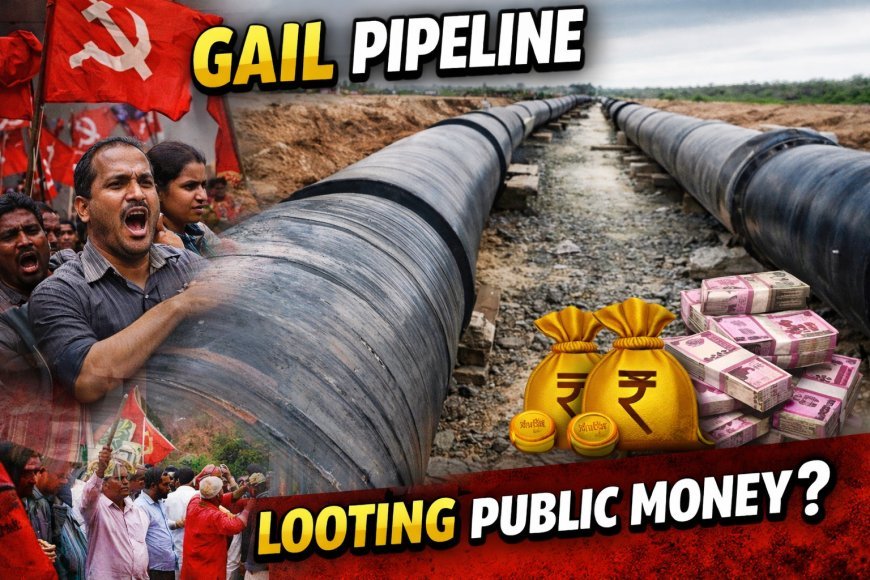


1. Before 2016 — CPM & Other Parties Protest (Safety/People’s Concerns)
Period: 2013–2015 (approx.)
Places: Kozhikode/Malappuram (North Kerala)
Who Protested: Local leadership of Communist Party of India (Marxist) (CPM) and other local political leaders
Reason for Protest:
-
CPM and local leaders raised public safety and land use concerns about the pipeline route affecting populated areas.
-
The protest stemmed from fears that pipeline alignment would threaten people and property in densely populated zones.
-
During this time CPM was in Opposition (under United Democratic Front government).
-
They backed local activists and the “GAIL Victims’ Forum” and publicly criticized the government’s handling of the project.
Why politically significant:
-
CPM’s support heightened political pressure on the project before 2016, tying it to broader concerns about development without consent.
-
This phase contributed to delays in the project’s progress.
2. November 2017 – Large Protests at Mukkom, Kodiyathoor
Date: 1–3 November 2017
Place: Mukkam and Kodiyathoor regions, Kozhikode district, Kerala
Political Involvement:
-
Local leaders of CPM initially supported protesters, while the Indian National Congress and Indian Union Muslim League (IUML) leaders spoke in solidarity with compensation demands though official support varied.
-
UDF (Congress-led coalition) called a hartal (shutdown) in protest of police action against protesters after clashes with police.
Reason for Protest:
-
Residents demanded realignment of the pipeline route away from densely populated areas and increased compensation to landowners.
Outcome / Political Response:
-
Protest turned violent after the police attempted to clear the area and prevent roadblocks.
-
The Kerala government called an all-party meeting on 6 November 2017 to discuss the protests.
3. November 3–6, 2017 – All-Party Engagement
Date: November 6, 2017
Place: District Collectorate, Kozhikode
Who Attended: Leaders from Congress, IUML, other local parties attended; CPM leadership and government officials also participated.
Reason:
-
Called by the Kerala government to allay fears and discuss compensation and safety concerns raised by protesters on the ground.
-
Opposition leaders expressed support for people’s demands on higher compensation and transparency.
4. Mid-November 2017 – Widened Protests with Political Participation
Date: Around November 19, 2017
Place: Multiple Panchayats across seven districts including Kozhikode and Malappuram
Who Participated:
-
Congress MP M I Shanavas attended anti-pipeline campaigner meetings and presided over actions calling for alignment change and compensation.
-
Other local political representatives, including local bodies’ heads, were involved in protests, indicating broad participation beyond fringe groups.
Reason:
-
Protesters again demanded route revision to avoid dense population, higher compensation, and release of arrested activists.
-
The broadening to multiple districts made the agitation a state-level political issue.
Key Political Reasons Behind these Protests
Here’s a summarised look at why political parties and their leaders joined or supported the agitation at different times:
Main Reasons for Political Party Protests
| Political Party | Timeframe | Reasons for Protest |
|---|---|---|
| CPM (in Opposition, pre-2016) | 2013-2015 | Safety concerns, people’s rights, against pipeline through populated areas. |
| CPM Local Leaders (2017) | Nov 2017 | Local participation in protests for realignment and compensation; national leadership later criticized violent protesters. |
| Congress & UDF Leaders | Nov 2017 | Protested police action, supported demands for compensation and better handling. |
| IUML Leaders | Nov 2017 | Joined protests over handling and compensation issues. |
| Fringe/Other parties (SDPI, Solidarity Youth Movement) | Nov 2017 | Actively led agitation alongside residents; criticized by CPM leadership. |
Important Notes on Political Dynamics
CPM’s Changing Position
-
While CPM opposed the project in opposition (raising public safety concerns), once it formed the Kerala government in 2016, the party’s official position shifted toward completing the project.
-
During the 2017 protests, state leadership accused protesters (and groups like SDPI) of exaggerating fears and politicizing the issue — even using inflammatory language against them.
Summary of Political Party Protests
✔ 2013-2015:
-
CPM and local leaders supported people’s protests citing safety and livelihood issues.
✔ Nov 2017 (Mukkam/Kodiyathoor):
-
Broad protests involving Congress, IUML, local CPM, and activists over route alignment and compensation.
✔ Nov 6, 2017:
-
All-party meeting to address protest grievances.
✔ Nov 19, 2017:
-
Wider state-level political involvement with leaders like MI Shanavas advocating demands.
Here’s a clear, factual analysis of the current layout plan of the GAIL pipeline in Kerala, changes made by the Left Democratic Front (LDF) government after coming to power, and how the political narrative around it has been shaped (including claims of “development showcase vs public cost”) — with citations from reliable sources:
1. Current Pipeline Layout (Core Structure)
The GAIL Kochi–Mangaluru natural gas pipeline in Kerala is part of a multi-state infrastructure project originally envisaged in 2007 to connect the LNG terminal at Kochi with Mangaluru and Bengaluru through:
-
Ernakulam District → Thrissur → Palakkad → Malappuram → Kozhikode → Kannur → Kasaragod → Mangaluru (Karnataka) route.
This route was designed to pass through densely populated rural and semi-urban land, agricultural fields, and residential plots — and that was one of the biggest reasons for resistance.
The pipeline ultimately carries liquefied natural gas (LNG) that will be regasified at Kochi and delivered as piped natural gas (PNG) and CNG to households, industries, and commercial units along the route.
2. Key Changes Made by the LDF Government After 2016
When the Left Democratic Front (LDF) came to power in Kerala in 2016, they did not alter the overall route significantly, but changed compensation and implementation policies — largely in response to protests and political pressure:
A. Compensation Policy (2017 Revision)
One of the most significant policy changes was the doubling of compensation for landowners whose land falls under the pipeline’s “Right of Use” (RoU) regime:
-
Compensation was increased from five times the revised fair value of land to ten times its fair value.
-
This revision was applied retrospectively from 2012, when the project began.
-
Owners with ≤10 cents of land (a small plot) were given special protections:
-
Pipeline width on these plots reduced to 2 metres (from 10 m).
-
Existing houses were protected, and alignment would avoid these plots where possible.
-
Ex-gratia payment of ₹5 lakh was offered to owners of such small plots.
-
-
Additional compensation was mandated for crop loss (e.g., paddy fields received an extra ₹3,761 per cent).
These changes were aimed at reducing the resistance from small landholders and at giving a political solution to the protest movement.
B. Technical Implementation and Alignment Adjustments
The government also worked with GAIL to ensure:
-
That the pipeline alignment avoids running beneath houses directly.
-
For plots without houses, alignment was shifted to one side of the property, leaving space for future construction.
-
Implementation planning used safer techniques in sensitive areas (e.g., horizontal directional drilling under waterlogged areas) — although this was more of an engineering choice and not a political decision.
C. Safety and Engagement with Landowners
In response to violent protests in late 2017, the LDF government:
-
Called all-party meetings to address claims of misalignment and inadequate compensation.
-
Claimed to have addressed safety concerns by involving officials, police outreach, and ensuring communication with affected villages.
-
Emphasised that houses would not be affected and that high compensation would soften resistance.
3. How the Government Portrays the Project (Political Narrative)
A. Development Showcase
The LDF, including Chief Minister Pinarayi Vijayan, has repeatedly presented the project as a major development achievement:
-
They argue that after years of stagnation and protests, the pipeline was completed only after the LDF proactively addressed issues.
-
The government and public officials depict the pipeline as a boost to Kerala’s clean energy ecosystem — helping PNG and CNG distribution, industry fuel supply, and economic growth.
-
Inauguration events (including one attended by the Prime Minister for the Kochi–Mangaluru stretch) were used as public affirmation of political leadership’s role in completion.
This narrative aligns with a broader political strategy: taking credit for project completion, even though original planning began long before their tenure.
B. Addressing Protests vs. Criticism
The LDF’s portrayal also includes:
-
Claiming they listened to public concerns and increased compensation substantially to pacify resistance.
-
Emphasising that houses and small plots were given special consideration — making the pipeline installation socially less disruptive.
-
At times, critics point out that the government’s narrative glosses over real land rights concerns and long-standing local opposition that existed before 2016. Protests continued even after the compensation hike.
4. Criticisms, Controversies, and Public Perception
A. “Delayed until politics favoured it” Argument
Many local critics and commentators highlight that:
-
The LDF government’s active support for the project only came after it won political power — even though the CPM (a key LDF party) had opposed the project when it was in the opposition, calling it unsafe and unsuitable for populated areas.
-
Opponents argue this pattern (oppose while out of power → champion while in power) reflects politically driven opportunism rather than genuine public interest.
B. Cost and Public Funds Concerns
-
The compensation hike involved significant public money — the state projected an additional ₹116 crore to cover increased compensation costs.
-
Critics claim that this increase was done without addressing deeper land rights and safety concerns, meaning money served as a “bribe” rather than a solution.
Such arguments are common in grassroots discussions on social media, where commentators point to political leverage and distribution of state resources rather than transparent public policy outcomes.
5. Overall Assessment
| Aspect | Objective Facts | Political/Controversial Interpretation |
|---|---|---|
| Route/Layout | Original pipeline follows national gas grid alignment from Kochi to Mangaluru. | Many locals and critics argue alignment through populated areas was a poor planning choice. |
| Changes by LDF | Compensation doubled, protections for small landholders introduced, house-protection alignment proposed. | Some view this as a political concession rather than a substantive safety fix. |
| Government Narrative | Government claims development success / completion. | Critics say this narrative politicizes public funds and delays to take credit. |
| Public Reaction | Mixed — some landowners accepted compensation, protests continued in some pockets. | Many grassroots activists say land rights and safety concerns remain unresolved. |
Conclusion
The LDF government did not drastically alter the pipeline’s original layout, but adjusted compensation, alignment protections, and public engagement mechanisms to reduce resistance and push the project forward. These moves helped the project’s completion and allowed political leadership to benefit from its inauguration and portrayal as a development success, even though critics maintain that deeper land rights and safety issues were never fully resolved.
What's Your Reaction?